

Skin in the Game
The Prince, The Confessions, and The Ashes of An Empire
1970s New York, Trump & Machiavelli: The Art of Power in a Dying City. Discover how a young "The Prince" leveraged a dying city's desperation to build a personal empire from nothing.
UNFILTEREDREAL ESTATEMONEY
In the 1970s, New York City was a bankrupt, decaying giant, far removed from the polished skyline we see today. Amidst the chaos of the Bronx burning and the city facing total financial collapse, a young Donald Trump emerged not just as a developer, but as a practitioner of pure Machiavellian pragmatism. By dissecting the Grand Hyatt deal, we explore how empires are built on the intersection of "The Prince’s" cold calculation and the raw, human vanity found in Rousseau’s "Confessions."
Trump didn’t just build with steel; he built with the currency of prestige, securing unprecedented tax breaks without spending a cent of his own. In a modern landscape saturated with AI-generated CEOs, synthesized LinkedIn dramas, and a collective loss of identity, this article revisits a time when real power required real risk and a terrifying clarity of will. It is a reminder that while the digital world thrives on algorithms, true history is forged by those who dare to manipulate the reality of the physical world.
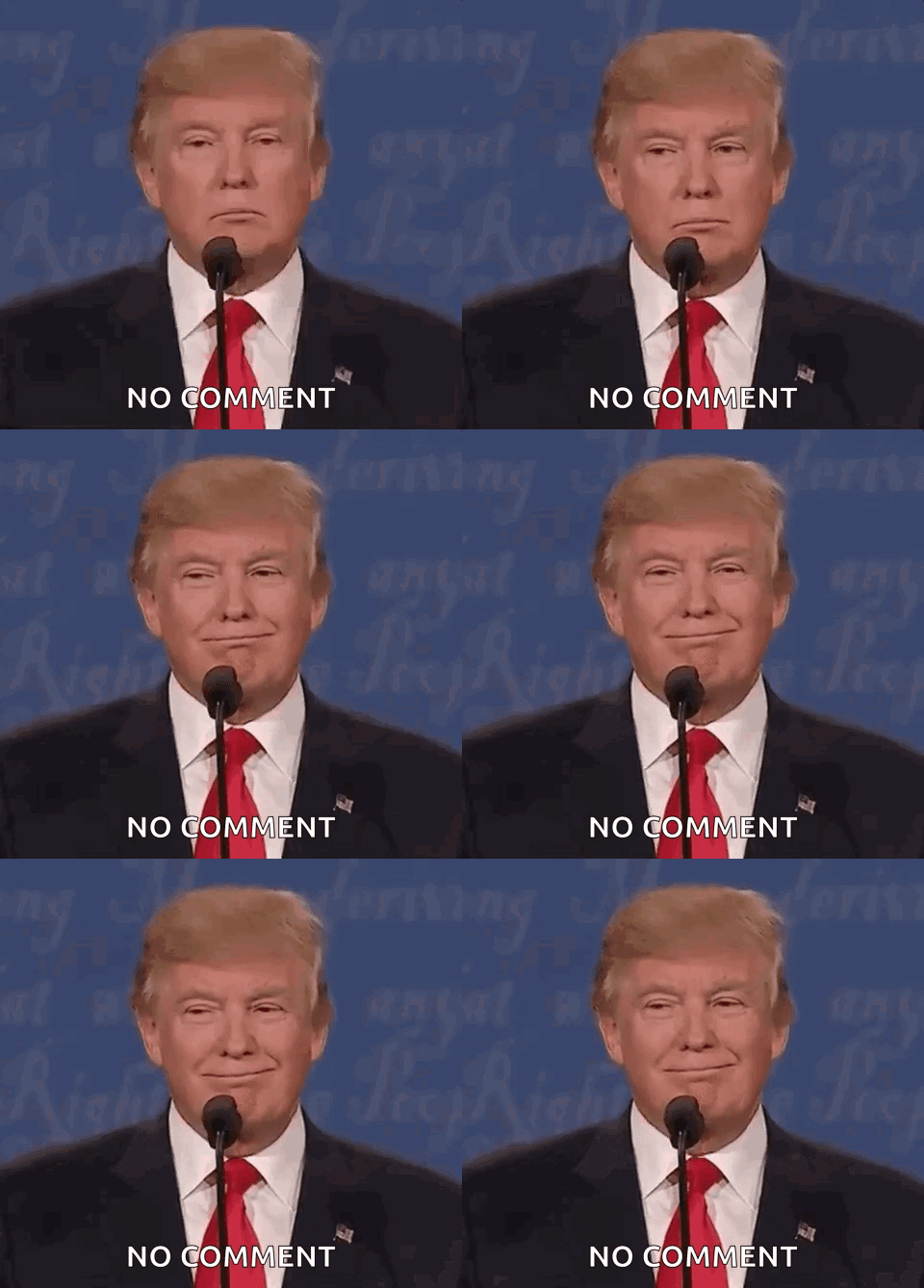
Before the gold towers, there was the grime of 1970s New York.
1970s New York didn't look like the shimmering postcards of today. The city was a dying giant, gasping for air amidst mountains of uncollected trash and soaring crime rates. The infamous New York Times headline, "Ford to City: Drop Dead," wasn't just a bold font; it was a death certificate for an empire. Subway cars were invisible under layers of graffiti, the Bronx was burning, and Wall Street was shrouded in darkness.
In the middle of this decay, a young man appeared with a vision and an empty pocket: Donald J. Trump.
The Prince Steps onto the Stage
Trump’s rise during that era was a physical manifestation of the cold-blooded pragmatism described in Machiavelli’s The Prince. Machiavelli argued: "The end justifies the means; the means will always be considered honorable and be praised by everyone."
When young Trump set his sights on the Grand Hyatt project (then the dilapidated Commodore Hotel), he had zero capital. But he orchestrated an illusion so grand that the city, the banks, and the investors believed he was holding all the cards. As Machiavelli suggested, he chose to be feared and respected rather than merely loved. He read the city's ruin as a map of opportunity. By securing a 40-year tax abatement, he began owning the city's future without spending a single cent of his own. This wasn't just construction; it was the coronation of a modern Prince.
Rousseau’s "Confessions" and the Power Paradox
On the flip side of the coin lies the staggering honesty of Jean-Jacques Rousseau’s Confessions. Rousseau laid bare the raw, often dark, and selfish desires of the human soul. To Rousseau, power should be a social contract, yet he observed how power-seekers inevitably forged their own chains of vanity and status.
Rousseau’s approach to power is a romantic tragedy; the story of man abandoning his "natural state" to be shackled by property and prestige. As Trump carved his name in gold into the heart of New York, he was the pinnacle of Rousseau’s "artificial man" created by society. He was "saving" the city, but in doing so, he was reshaping its soul into his own image. Rousseau, in describing how a man constructs his public persona, was essentially predicting the Trump of the '70s: a figure creating his own myth, presenting even his flaws as monuments to victory.
A Fortune Built on Thin Air
Many assume Trump was born into wealth. That is the great misconception. In the '70s, he was a master of spending "future power" today. He convinced banks that if his hotel weren't built, New York would collapse, and their existing debts would turn to dust. This is a masterclass in Machiavellian crisis management. No money changed hands; he sold something far more valuable: Urgency and Prestige.
The intersection where Rousseau’s human vulnerabilities met Machiavelli’s sharp intellect was 42nd Street. The road from the rotting streets of old New York to today’s ultra-luxury towers wasn't paved with concrete alone; it was built on an insatiable hunger for power, the art of manipulation, and the sheer will to create something from nothing.
The Modern Decay: A World of Digital CEOs
Today, we live in a different kind of ruin. A digital one. In an era where AI can generate a "visionary" persona in seconds, everyone has become a CEO. LinkedIn is a masquerade of "thought leaders" and synthesized dramas where the human edge is being traded for algorithmic approval. People are forgetting their own identities, drowning in a sea of manufactured success and AI-generated noise.
Those "entrepreneurs" posting platitudes today wouldn't have survived a single afternoon in the grime of 1970s New York. While they wait for an algorithm to tell them who to be, figures like the young Trump - driven by a Machiavellian fire - forced reality to bend to their will. Power belongs to those who dare to be authentic in their ambition, not those who hide behind a digital mask.
In this world of rising costs and fading identities, understanding the true value of your surroundings is the only real "Intelligence." Before you decide to build your own empire or simply find your place in the sun, you must know what the ground beneath you is worth.
For a grounded look at the reality of living in today’s hubs of power, explore the Cost of Living in Malta and see where you truly stand. Show must go on.
Address
21 De Tigne Triq Ix-Xatt SLM 3010 Sliema - Malta
Contacts
+356 99270417 - hello@freemalta.com
Powered by MaltaInsider.com – The Heart of Strategic Intelligence. © 2026 FreeMalta.com. All Rights Reserved. Infrastructure of Truth.™



Home | The Story | Off The Record | About Us | Contact | Editorial Policy
Fierce & Tame Limited (C 115080) is a company registered and incorporated in Malta under the Companies Act, Chapter 386 of the Laws of Malta.
All brands and digital assets listed herein are operated by or in association with Fierce & Tame Limited. This website does not constitute legal, financial, or investment advice.